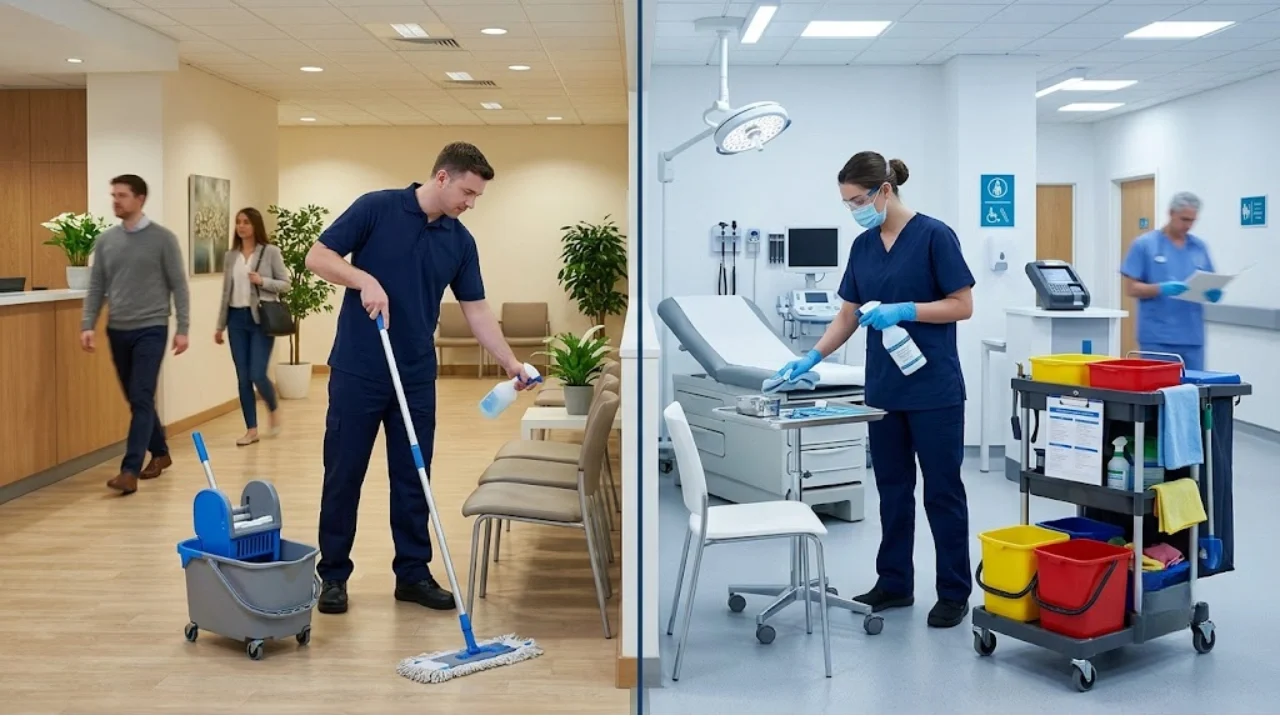
At first glance, a healthcare facility and an office building may appear to have similar cleaning requirements.
Both contain floors, washrooms, reception areas, staff rooms and workspaces.
This often leads some facility managers to believe that any commercial cleaning provider can maintain a healthcare environment.
The reality is very different.
Healthcare facilities operate in environments where hygiene standards directly influence patient safety, staff wellbeing and public confidence. Cleaning requirements extend far beyond keeping a building tidy and presentable.
This is why specialised healthcare cleaning has become an essential service for clinics, medical centres, physiotherapy practices and healthcare facilities throughout Dublin.
Not Every Cleaning Environment Carries the Same Risks
A standard office typically accommodates employees performing administrative tasks.
A healthcare facility welcomes people with various health conditions, medical concerns and vulnerabilities.
Patients may include:
- Older adults
- Children
- Individuals recovering from illness
- People with weakened immune systems
- Patients receiving ongoing treatment
The risks associated with contamination are significantly higher than those found in many commercial workplaces.
As a result, cleaning procedures must be tailored to the environment rather than copied from standard office cleaning programmes.
Healthcare Cleaning is About More Than Appearance
In many commercial settings, cleaning focuses primarily on presentation.
Objectives often include:
- Dust free surfaces
- Clean floors
- Tidy washrooms
- Presentable meeting rooms
While appearance remains important in healthcare environments, it is only one part of the equation.
Healthcare cleaning also supports:
- Infection prevention
- Contamination control
- Patient confidence
- Workplace hygiene
- Risk reduction
A facility can look clean while still falling short of the standards expected within a healthcare setting.
The Daily Traffic Is Completely Different
Many commercial offices have relatively predictable occupancy levels.
Healthcare facilities experience constant movement throughout the day.
Patients, visitors, clinicians, therapists, administrative teams and contractors may all interact with the same spaces.
This increased activity means:
- More touch points
- Greater contamination potential
- Increased cleaning demands
- Higher expectations for hygiene
Cleaning schedules must account for these operational realities.
Treatment Areas Require a Different Approach
One of the biggest differences between healthcare cleaning and commercial cleaning involves treatment spaces.
Healthcare facilities may contain:
- Examination rooms
- Consultation rooms
- Physiotherapy treatment areas
- Diagnostic spaces
- Procedure rooms
These areas require careful attention because patients interact directly with furniture, equipment and treatment surfaces.
Professional healthcare cleaning programmes focus on maintaining these environments consistently throughout the day.
General office cleaning programmes are rarely designed with these requirements in mind.
Staff Training Matters More Than Many Realise
A cleaner who excels in commercial office cleaning may not automatically be prepared for healthcare environments.
Healthcare facilities often require additional knowledge regarding:
- Cross contamination prevention
- Cleaning sequences
- Surface specific procedures
- Disinfection practices
- High risk touch points
- Clinical environment protocols
Without proper training, important details may be missed.
Specialist healthcare cleaning teams are typically trained to recognise and address these unique challenges.
High Touch Areas Demand Greater Attention
Every workplace contains touch points.
Healthcare facilities simply have more of them.
Examples include:
- Reception counters
- Treatment beds
- Door handles
- Light switches
- Waiting room seating
- Handrails
- Payment terminals
- Sign in screens
These areas often require more frequent cleaning and disinfection than standard office environments.
A healthcare specific cleaning programme identifies these locations and ensures they receive appropriate attention.
Cleaning Frequency Is Usually Higher
Many commercial buildings can function effectively with cleaning performed once each day.
Healthcare environments often require a more structured schedule.
Depending on patient numbers and facility activity, cleaning may need to occur:
- Before opening
- During operating hours
- Between busy periods
- After closing
This layered approach helps maintain hygiene standards throughout the day rather than only at the beginning or end of operations.
Documentation Supports Accountability
Healthcare organisations often place a strong emphasis on procedures and record keeping.
Cleaning should be no different.
Specialist healthcare cleaning providers commonly use documented systems that help track:
- Completed tasks
- Inspection results
- Cleaning schedules
- Quality checks
- Corrective actions
This creates greater accountability and consistency across the facility.
In contrast, some commercial cleaning programmes rely primarily on visual inspections without detailed documentation.
Washrooms Carry Higher Expectations
Patients often form opinions about an entire healthcare facility based on the condition of its washrooms.
A spotless treatment room can quickly lose its impact if washroom hygiene falls below expectations.
Healthcare washrooms require:
- Frequent checks
- Ongoing replenishment
- Consistent cleaning
- Attention to touch points
- Odour control
Maintaining these standards requires a structured approach rather than occasional maintenance.
Patient Confidence Is Directly Linked to Cleanliness
When patients enter a healthcare facility, they make judgments within seconds.
They notice:
- Floors
- Reception areas
- Seating
- Washrooms
- Treatment rooms
- General presentation
Cleanliness influences how people perceive professionalism, safety and quality of care.
A visibly well maintained environment helps reinforce trust before any treatment even begins.
Specialist Cleaning Helps Protect Your Reputation
Healthcare facilities spend years building strong reputations within their communities.
Poor cleaning standards can undermine that trust surprisingly quickly.
Negative impressions often stem from:
- Dirty washrooms
- Dusty surfaces
- Unpleasant odours
- Untidy waiting areas
- Missed cleaning tasks
A professional healthcare cleaning programme helps protect the reputation that organisations work so hard to establish.
Equipment and Furnishings Often Need Extra Care
Healthcare facilities contain specialised furniture and equipment that may require careful handling.
Examples include:
- Examination couches
- Therapy equipment
- Clinical seating
- Diagnostic equipment
- Medical storage units
Cleaning teams working in healthcare environments must understand how to maintain these assets appropriately while preserving their condition.
Commercial Cleaning and Healthcare Cleaning: A Quick Comparison
| Area | General Commercial Cleaning | Specialised Healthcare Cleaning |
|---|---|---|
| Main Objective | Appearance and maintenance | Hygiene, safety and presentation |
| Cleaning Frequency | Usually once daily | Often multiple times daily |
| Staff Training | General cleaning skills | Healthcare specific procedures |
| Touch Point Focus | Standard attention | Enhanced attention |
| Documentation | Limited in many cases | Structured monitoring |
| Patient Considerations | Not applicable | High priority |
| Risk Management | Basic | Ongoing focus |
PRO TIP
When reviewing a cleaning provider, ask how they would clean a treatment room differently from a standard office meeting room.
The answer often reveals whether they genuinely understand healthcare environments or simply apply a generic commercial cleaning model.
Questions Worth Asking Before Appointing a Cleaning Provider
Healthcare facility managers should consider asking:
Have you worked within healthcare environments before?
How do you identify high priority cleaning areas?
What quality control measures are in place?
How are staff trained for healthcare settings?
How often are cleaning procedures reviewed?
The quality of the answers can reveal a great deal about the provider’s experience and approach.
The Cost of Using the Wrong Cleaning Approach
Healthcare facilities sometimes select cleaning services based primarily on price.
While cost matters, the cheapest option is not always the most suitable.
An inappropriate cleaning programme may lead to:
- Reduced patient confidence
- Increased complaints
- Poor hygiene standards
- Additional corrective cleaning costs
- Damage to reputation
The long term consequences often outweigh any short term savings.
A Different Standard for a Different Environment
Healthcare facilities are not ordinary workplaces.
The people entering these environments expect a higher standard of cleanliness because their health and wellbeing matter.
That expectation should be reflected in the cleaning programme supporting the facility.
At Dublin Clean, healthcare cleaning is approached differently from standard commercial cleaning. Rather than applying a generic checklist, cleaning plans are developed around patient flow, treatment areas, facility usage and operational requirements.
The result is a cleaning programme designed specifically for healthcare environments where consistency, professionalism and hygiene standards remain critical every day.
For healthcare providers across Dublin, specialised cleaning is not an added extra. It is part of creating a facility where patients feel comfortable, staff can work confidently and high standards are maintained throughout the year.