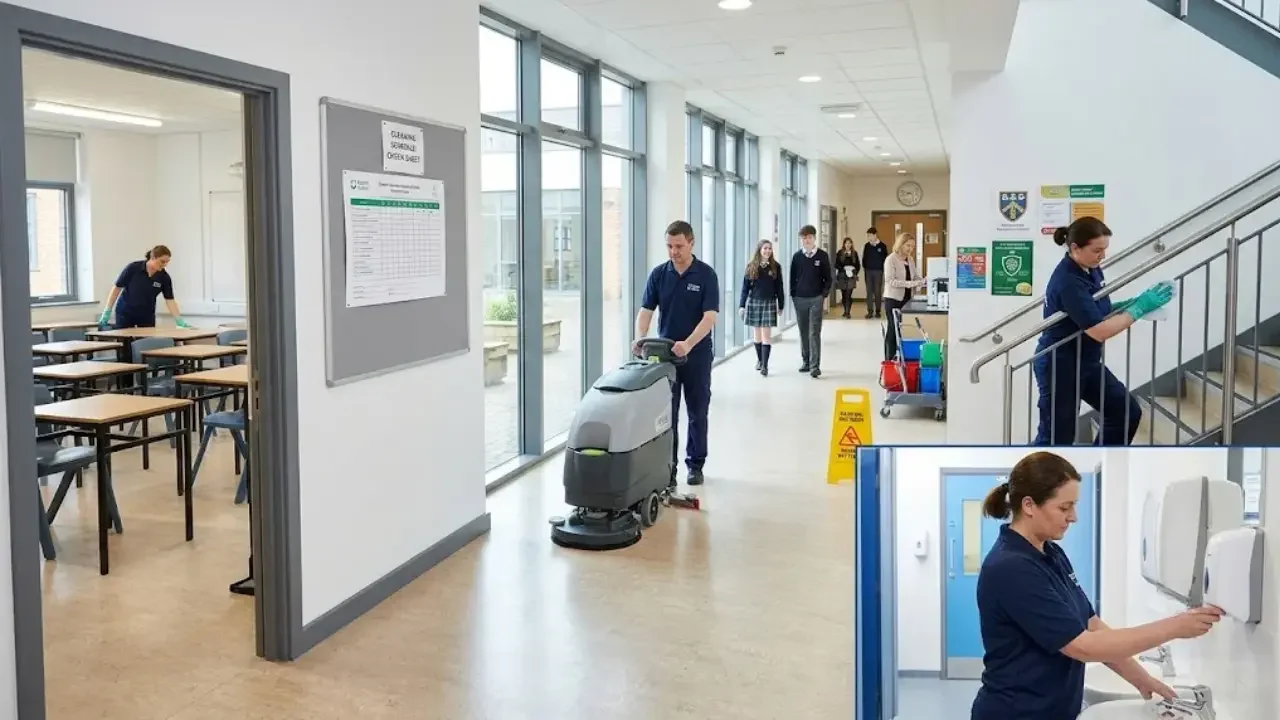
A clean school supports a better learning environment. Classrooms need attention after lessons, washrooms require regular checks and shared spaces must remain presentable throughout the school day. For school principals, boards of management and facility managers, the challenge is making sure these standards are maintained consistently, not just before an inspection or a school event.
Appointing a professional cleaning contractor should give the school a clear service plan, trained staff and a reliable way to check the quality of the work. The agreement should also account for term time demands, school holidays, unexpected incidents and the different needs of classrooms, sports halls, canteens and sanitary facilities.
For schools in Dublin, the key is to look beyond a promise to keep the building clean. The contractor should be able to explain exactly what will be cleaned, how often each task will be completed and how the school can verify the results.
1. A Written Cleaning Specification
The first thing a school should expect is a written cleaning specification. This document sets out the work covered by the contract, the expected standard, the frequency of each task and the person responsible for checking the results.
The Irish Department of Education provides health and safety guidance to help schools manage a safe environment for pupils, staff and visitors. Schools also have workplace safety responsibilities under Irish legislation. A cleaning contract should support the school’s existing safety arrangements rather than operate separately from them.
Source: Department of Education and Youth
A clear specification should identify the following:
• Areas included in the contract, from classrooms and corridors to staff rooms and washrooms.
• Tasks required in each area, including floor care, surface cleaning, waste removal and replenishment of consumables.
• Cleaning frequencies during term time, school holidays and periods of unusually high use.
• Inspection procedures, reporting arrangements and responsibility for correcting missed tasks.
Without these details, the school may pay for a service that does not meet its actual needs.
2. Daily Cleaning That Matches School Activity
School buildings experience considerable activity throughout the day. Pupils move between classrooms, use shared desks and chairs, visit washrooms and gather in corridors during breaks. A cleaning plan needs to reflect this pattern of use.
Routine cleaning should normally take place daily in occupied school environments. The precise tasks and frequency should reflect the area’s use, visible soiling, the school’s risk assessment and any relevant health guidance. Irish guidance for childcare and educational settings recommends written cleaning policies and rotas that identify the areas, methods and frequency of cleaning.
Source: HSE Health Protection Surveillance Centre
A contractor should be able to distinguish between work that must be completed every day and tasks that can be scheduled weekly or during school holidays. This prevents important jobs from being missed while helping the school manage its cleaning budget sensibly.
| School area | Cleaning expectations |
| Classrooms | Desks, accessible surfaces, floors and bins maintained |
| Corridors and entrances | Floors and visible dirt managed, with attention to busy access points |
| Washrooms | Toilets, sinks, taps and touch points cleaned, with supplies replenished |
| Staff rooms | Tables, work surfaces, floors and waste areas maintained |
| Canteens | Tables and food contact surfaces cleaned using suitable procedures |
| Sports halls | Floor care carried out using products and methods suitable for the surface |
| Reception | Counters, entrance glass, floors and frequently touched surfaces maintained |
The school and contractor should agree the exact scope and frequency for each area before work begins.
3. Safe Cleaning Products and Proper Chemical Handling
Schools need a contractor that treats chemical safety seriously. Cleaning products must be suitable for the surfaces being treated and used according to the manufacturer’s instructions. Incorrect dilution, poor storage or the mixing of incompatible products can create avoidable risks.
Ask the contractor how products are selected, labelled, stored and transported around the building. Staff should receive suitable training in safe handling and know which products can be used on classroom furniture, sports flooring, washroom surfaces and food preparation areas.
The school should also know how cleaning chemicals will be stored securely away from pupils. Risk assessments, safety data sheets and appropriate protective equipment should be available where required.
PRO TIP: Ask for a list of the main cleaning products used on site and the procedures for handling them. This makes it easier for the school to review chemical safety arrangements and identify any products that may be unsuitable for particular surfaces.
4. Cross Contamination Prevention
Using the same cleaning cloth or equipment throughout a school can transfer dirt and microorganisms between different areas. A professional contractor should have a clear procedure for managing cleaning equipment and preventing this problem.
Colour coded cloths and equipment can help staff keep separate areas apart, such as washrooms, general classrooms and food preparation spaces. The colours used should follow a documented system that all cleaning staff understand. Equipment must also be cleaned, dried and stored properly after use. These practices are consistent with infection prevention advice published by Ireland’s HSE Health Protection Surveillance Centre.
The contractor should explain how it manages reusable cloths, mop heads, buckets and other equipment. School management should not have to guess if the equipment used in a canteen has also been used in a toilet area.
5. Washroom Hygiene and Replenishment
Washrooms deserve particular attention because they are used repeatedly throughout the school day. A morning clean alone may not be enough for a busy school, especially when pupil numbers are high or facilities are shared by several year groups.
The agreed service should cover toilet bowls, sinks, taps, cubicle touch points, floors and other relevant surfaces. Soap, toilet paper and hand drying supplies should be checked and replenished as agreed. The contractor should also have a clear method for reporting plumbing problems, damage or persistent odours that cleaning alone cannot resolve.
Schools should ask how washrooms are monitored between scheduled cleans. Regular checks during the day may be necessary in heavily used facilities, with the frequency based on pupil numbers and actual conditions.
6. Cleaning During Term Time and School Holidays
A school does not operate in the same way throughout the year. During term time, cleaners must work around lessons, staff activities and access restrictions. During holidays, the building may offer a better opportunity for deeper cleaning and maintenance.
The contract should distinguish between routine cleaning and periodic tasks. The UK Department for Education’s school cleaning procurement guidance provides a useful planning example by separating daily duties from periodic work and identifying tasks that may be completed during school holidays. Irish schools should apply their own procurement arrangements and local requirements.
A practical annual schedule might include:
| Period | Possible cleaning priorities |
| School term | Routine classroom cleaning, washrooms, bins and shared spaces |
| Midterm breaks | Additional attention to selected areas and accumulated dirt |
| Easter or other longer breaks | Planned floor care and selected detailed cleaning |
| Summer holidays | Deep cleaning, accessible high level dusting and specialist floor treatments where needed |
| Before reopening | Final presentation checks and confirmation that rooms are ready for use |
The final schedule should reflect the school’s premises, resources and agreed contract. Holiday cleaning should not be assumed to be included unless it is written into the service specification.
7. Trained Staff and Reliable Cover
A cleaning contract is only as reliable as the people delivering it. Schools should expect staff to know the agreed procedures, use equipment safely, respect restricted areas and report problems rather than leave them unresolved.
Ask how new staff are trained and how the contractor maintains standards when employees are absent or replaced. The school should also agree arrangements for site access, keys, alarms and securing the building after cleaning.
Because cleaners work in an environment used by children, the school should confirm the applicable vetting and safeguarding requirements with the contractor and its own management team. The arrangements should reflect Irish law and the school’s policies, rather than relying on procedures designed for another country.
8. Inspection Records and Accountability
A contractor should be able to demonstrate that the agreed work has been completed. Verbal assurances alone make it difficult for school management to identify recurring issues or assess performance over time.
A practical quality system can include signed or electronic cleaning records, scheduled inspections, a way to report defects and a documented process for correcting problems. The school should know who reviews the records, who receives complaints and how quickly issues are expected to be addressed.
Consider agreeing a monthly service review that looks at missed tasks, complaints, staffing cover and any changes needed to the cleaning schedule. This creates a regular opportunity to improve performance before small problems become persistent.
PRO TIP: Inspect a selection of classrooms and washrooms at different times, not only immediately after the cleaners finish. This helps the school assess how well the service holds up during normal use.
9. Waste Management and Unexpected Incidents
School cleaning involves more than emptying classroom bins. The contractor should understand the agreed arrangements for general waste, recycling and any special waste streams managed by the school. Waste should be removed safely and taken to the designated collection points.
The contract should also explain how the team responds to unexpected incidents, such as a spill, a broken container or an area that needs urgent cleaning. Staff should know whom to contact and how the affected space will be managed until it is safe to use again.
For incidents involving blood or other bodily fluids, ordinary cleaning alone may not be sufficient. The response should follow the school’s procedures and relevant health guidance, using appropriate protective equipment and products. The contractor should not improvise a response to a potentially hazardous incident.
10. What Should School Management Check Before Signing?
Before appointing a contractor, school management should assess both the proposed service and the company’s ability to deliver it consistently. A low quotation is not useful if important areas are excluded, staff cover is unreliable or the school cannot verify the work.
Use the following checklist when reviewing proposals.
| Assessment point | What the school should request |
| Scope of work | A written specification covering every agreed area |
| Staff training | Details of training and supervision |
| Chemical safety | Product information and safe handling procedures |
| Cleaning schedule | Daily, periodic and holiday tasks |
| Quality assurance | Inspection records and corrective action process |
| Staffing cover | Arrangements for absence and replacement staff |
| Insurance | Relevant current insurance documentation |
| Security | Agreed procedures for access, keys and alarms |
| Communication | Named contact for service issues |
| Pricing | Clear details of included work and additional charges |
The school should compare proposals against the same specification so that the assessment reflects service quality as well as price.
How Dublin Clean Can Support Your School
Dublin Clean understands that school cleaning must fit around the daily demands of an educational setting. Classrooms, washrooms, staff rooms and shared facilities each have different requirements, and the service needs to reflect how the building is used throughout the school year.
Our approach starts with a discussion about the premises, the areas requiring attention and the schedule that suits the school. This helps establish a clear scope of work and a practical plan for maintaining the agreed standards. We focus on commercial cleaning for educational facilities, with attention to reliability, communication and consistent service delivery.
For schools looking for school cleaning in Dublin, the priority should be a contractor that can explain its procedures, document its responsibilities and work with school management to address problems promptly. Dublin Clean can discuss your premises and prepare a cleaning proposal based on the work required.
Arrange a School Cleaning Assessment
A school should not have to chase its cleaning contractor to find out what has been done. The service should have clear responsibilities, an agreed schedule and a reliable way to check the results.
If your school is reviewing its current arrangements or preparing to appoint a new provider, contact Dublin Clean to discuss the premises, term time requirements and holiday cleaning needs. A site assessment can help establish the work involved and provide a clear basis for a quotation.